
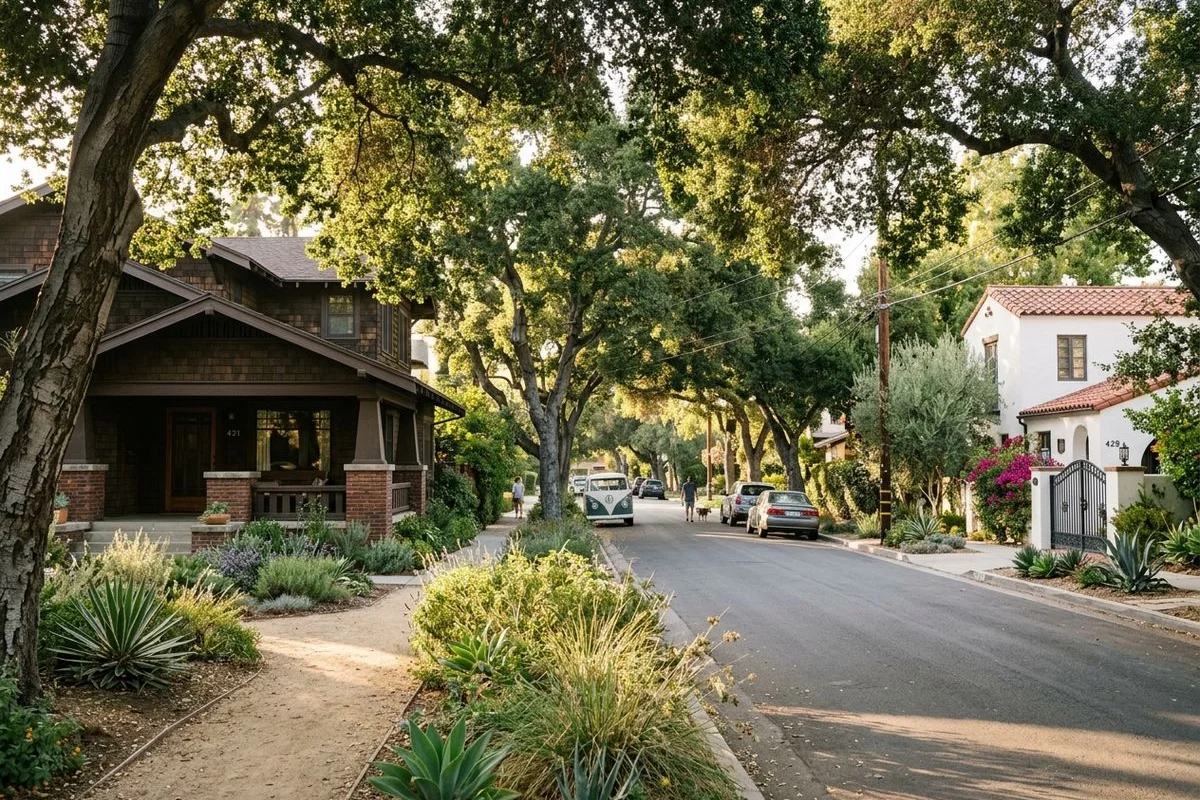
Water-Efficient Landscaping for Sunny and Sloped Properties
Sunny, sloped properties ask more of a landscape than flat ground ever will. They shed water quickly, heat up fast, and tend to expose every weakness in soil, planting, and irrigation. If the design is wrong, you see it right away, bare patches on the slope, runoff after a deep watering, plants that thrive on the shady side and struggle everywhere else, and a yard that looks thirsty no matter how often it gets watered.
That is why water-efficient landscaping on a hillside is never just a matter of swapping grass for drought-tolerant plants. It is a combination of landscape design, drainage, irrigation planning, and plant selection that respects the site instead of fighting it. On sunny properties, especially those with slopes, the best results usually come from working with the terrain. In places like the San Gabriel Valley, where hillside landscaping has a strong visual presence and wildfire concerns are never far from the conversation, the stakes are even higher. A good landscape has to conserve water, resist erosion, and still feel like it belongs to the property.
Start with the land, not the plant list
One of the most common mistakes I see is starting with a palette of attractive plants before studying how the site behaves. On a sloped property, that is backwards. The first question is how water moves across the ground, where it pools, where it disappears, and how much sun the slope gets through the day. California’s water conservation guidance puts that sequence front and center for a reason. Irrigation, soil, sun exposure, and plant selection all need to be considered before turf comes out or a new planting plan goes in.
That may sound obvious, but in practice it changes everything. A south-facing slope that bakes from morning to late afternoon is a very different environment from a north-facing one that stays cooler and holds moisture longer. Even a few degrees of slope angle can alter how quickly soil dries after watering or rain. In landscape design, those differences matter more than the plant label does. A plant that is perfectly happy in one part of the yard can struggle ten feet away if the exposure changes.
Soil deserves just as much attention as light. Thin, rocky soil on a hillside drains quickly, which is useful for many California native plants but can be punishing if the wrong species are installed. Heavier soil may hold water longer, but on a slope it can also encourage runoff if irrigation is poorly tuned. Before anyone starts reworking a property, it pays to understand whether the site needs better infiltration, more erosion control, or simply a better irrigation schedule.
Why slopes demand a different kind of water efficiency
A flat yard gives you time. Water soaks in, roots can explore, and surface erosion is usually limited. On a slope, gravity is the main force. Water moves downhill before plants have a chance to use it, and that can leave the upper part of the slope dry while the lower edge gets too much water. The result is often wasted irrigation and stressed plants at the same time.
This is where hillside landscaping calls for restraint and structure. Instead of trying to saturate the entire slope with the same pattern, a better approach is to break the area into functional zones. Terraces, swales, planting pockets, and carefully placed hardscaping can slow water long enough for soil to absorb it. In the best projects, the landscape does not just look better, it works better with every rainfall and every irrigation cycle.
Hardscaping has an important role here, but it should be used thoughtfully. A retaining wall, a decomposed granite path, a set of steps, or a dry creek-style drainage feature can all help shape water movement and reduce erosion pressure. The point is not to pave over the problem. The point is to give water a controlled path and to reduce the amount of bare soil exposed to sun and runoff. On a steep site, even a modest bit of hardscaping can make planting more successful because it stabilizes the ground and creates microclimates.
There is also a visual benefit. Sloped properties can feel severe if everything is planted in the same manner from top to bottom. When hardscaping is part of the design, it gives the eye a place to rest and helps define planting beds that are easier to maintain. The result is usually cleaner, more intentional, and far more practical than a slope treated as a single giant bed.
Choosing plants that fit heat, slope, and local conditions
Plant selection is where water-efficient landscaping either comes together or falls apart. For sunny, sloped properties, the best choices are usually drought resistant landscaping plants that can handle reflected heat, quick drainage, and occasional dryness once established. In California, native and climate-appropriate plants have an obvious advantage because they are adapted to local conditions and often fit into water-wise design more naturally than thirsty ornamentals.
The California Department of Water Resources points property owners toward plant selection tools such as WUCOLS, which helps match plants to regional water needs. That kind of guidance is useful because not all drought-tolerant plants behave the same way. Some need regular deep watering while they establish, then very little afterward. Others can take reflected heat but want better soil. The practical lesson is simple: drought tolerance is not a single trait, and it should never be treated that way in a landscape plan.
For the San Gabriel Valley and similar foothill settings, plants such as California buckwheat, California sagebrush, manzanita, ceanothus, monkeyflower, foothill penstemon, bunchgrasses, and San Gabriel oak can make sense in the right locations. These species are not decorative filler. They are part of a broader strategy that supports native habitat gardening, keeps water use in check, and fits the character of local landscapes. On a sunny slope, they often perform better than species that demand richer soil or more frequent irrigation.
The best designs use plant communities rather than isolated specimens. A few manzanitas scattered into a bed of plants that all want different watering schedules can create maintenance headaches. But a grouping of compatible species, with similar water needs and exposure tolerance, is easier to irrigate and more resilient over time. That is one of the central principles of landscape design in drought-prone areas. Efficiency comes from matching plant needs, not from forcing every bed to look identical.
Irrigation retrofits often matter more than irrigation volume
I have seen homeowners cut irrigation time by a large amount and still end up with an unhealthy landscape because the system itself was poorly designed. On sloped properties, the details of irrigation matter enormously. Water that runs down a slope before it infiltrates is water that never reaches the roots where it is needed.
Drip irrigation is often a strong choice for water-efficient landscapes because it delivers water directly to the root zone and reduces spray loss. That said, drip is not automatically perfect. If emitters are spaced badly, if the soil is compacted, or if the slope is too steep without any checks on runoff, even drip can underperform. The system has to be laid out with the terrain in mind. Pressure regulation, matched emitters, and zone separation all help keep watering consistent from top to bottom.
Retrofitting an older yard usually starts with a hard look at what is already there. If the property still has turf in spots that serve little functional purpose, that is often the first area to reconsider. Turf removal can significantly reduce water demand, but only if the replacement design is equally thoughtful. Replacing grass with decorative gravel and a few struggling shrubs is not a water-wise landscape. Replacing it with suitable plant groupings, permeable surfaces, and a tuned irrigation system is a different matter entirely.
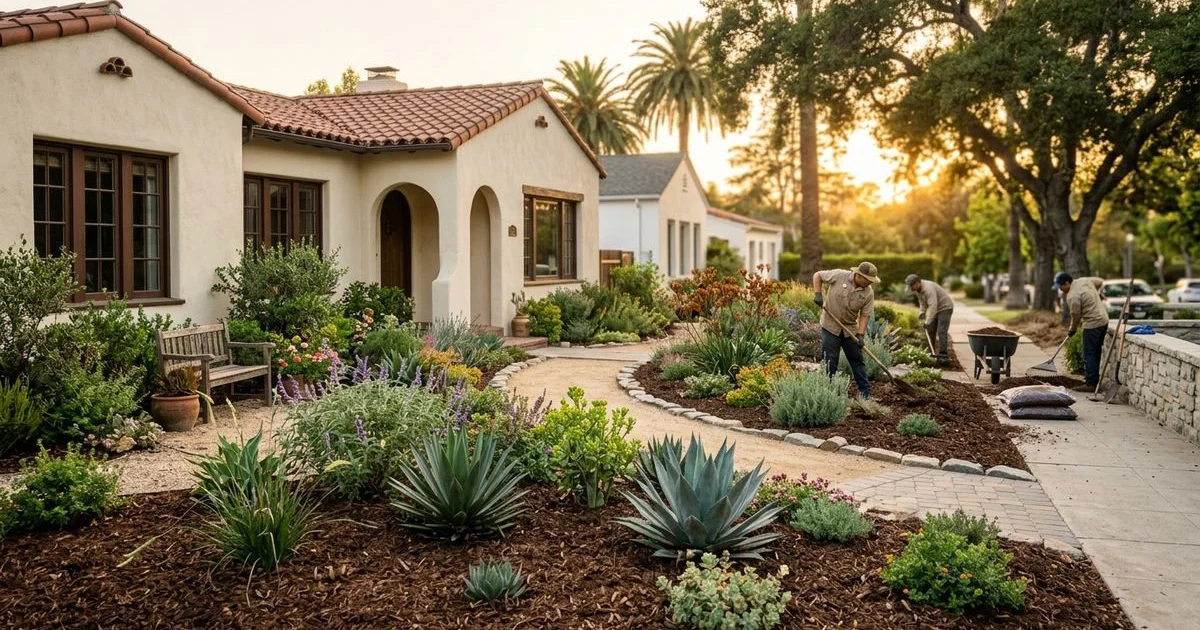
Soil preparation also affects irrigation efficiency. On slopes, amendments should be used carefully. Overbuilding the soil can create a layer that holds moisture differently than the native soil below it, which sometimes causes water to perch rather than move into the root zone. In many cases, improving planting pockets and using mulch wisely will do more for plant establishment than trying to re-engineer the entire hillside.
Erosion control is not optional
Sunny slopes are vulnerable to erosion even before plants are installed. Add irrigation or a heavy rain, and the problem can escalate quickly. That is why erosion control should be considered from the first sketch of a hillside project. It is not a separate issue from water-efficient landscaping. It is one of the core reasons water-efficient landscaping matters on a slope in the first place.
Mulch can help, but it must be used properly. A thin, even layer helps protect bare soil, reduce evaporation, and soften the impact of water. Too little mulch leaves soil exposed. Too much can smother low-growing plants or shift downhill after watering. On exposed slopes, mulch often works best when it is paired with plants that root in and stabilize the soil over time.
Terracing, groundcovers, and clusters of shrubs can all reduce the amount of loose soil on a hill. In fire-prone areas, though, erosion control and firewise planting need to be balanced carefully. The goal is not dense, dry fuel close to the house, nor is it a stripped, barren slope that washes away in the first strong watering. The best hillside landscaping has layers of function. Plants hold soil, hardscaping interrupts runoff, and irrigation is calibrated so the slope is supported without being saturated.
The California Native Plant Society has emphasized that slopes benefit from drought tolerance, erosion control, and firewise planting. That combination reflects real conditions on the ground. In foothill communities, you rarely have the luxury of designing for just one constraint. Water, slope, and fire all shape the outcome at once.
Firewise planning and water efficiency can work together
There is a persistent myth that a fire-aware landscape must look barren or heavily paved. That is not true. Fire-resistant planting and water-efficient design overlap more than many property owners realize. Plants that are properly sited, kept healthy, and spaced to avoid continuous fuel can support both goals. The problem usually begins when landscapes are overwatered, overgrown, or arranged without attention to defensible-space planning.
Local guidance from the San Gabriel Mountains region underscores the importance of ember-resistant zone rules and the use of native plants suited to the area. That matters because the landscape around the home should not become a liability. On sunny slopes, especially where dry conditions and wildfire risk are part of the landscape reality, plant choice and placement have to support access, visibility, and maintenance.
A firewise landscape is not only about species selection. It is also about geometry. A slope that has clear plant groupings, controlled spacing, and limited fuel near structures is easier to maintain and safer to live with. Hardscaping can help here as well, since stone paths, steps, and retaining elements can interrupt a continuous run of vegetation and give maintenance crews or homeowners better access.
When people ask whether drought resistant landscaping and firewise landscaping are in tension, my answer is usually that they should reinforce each other. A landscape that wastes water is often a landscape that has weak plant health. A landscape that is too dense or overgrown can be difficult to irrigate evenly and harder to defend in a fire-conscious design. Thoughtful planning solves both problems at once.
HOA rules and local water restrictions are part of the picture
Homeowners often assume that association rules can override conservation goals, but California water-restriction guidance makes clear that homeowners’ associations cannot prohibit certain water-efficient landscaping choices during drought-related restrictions. That matters in communities where visual standards are tightly managed. It means property owners may have more room to pursue water-wise changes than they think, even when they are working within an HOA framework.
That does not eliminate the need for good communication. In my experience, the best outcomes come when the landscape plan is presented as an improvement in both appearance and performance. Mature drought-tolerant plantings, clean hardscaping, and a well-organized hillside read as intentional. A patchy or rushed turf removal project does not. If there is a shared concern in a neighborhood, it is usually aesthetics, not conservation itself. A carefully drawn landscape design tends to answer both.
For new construction and renovation in California, the Model Water Efficient Landscape Ordinance also shapes expectations by encouraging native and climate-appropriate plants, efficient irrigation, and alternative water sources where appropriate. Even if a property is not a perfect textbook case, that framework sends a clear message. Water use has to be part of the design, not an afterthought.
What a practical redesign usually looks like
The most successful water-efficient slope projects usually unfold in stages. First comes assessment, then drainage and irrigation corrections, and only after that the actual planting. It is tempting to begin with the fun part, but the slope rarely rewards impatience. A property with a sunny grade may need one set of plants near the top, another in the middle, and a more durable, soil-holding group near the bottom where runoff collects.
A real-world project might replace thirsty lawn with a combination of native shrubs, bunchgrasses, and low groundcovers that fit the exposure. A retaining edge or small terrace could divide the slope into smaller, easier-to-water zones. Drip irrigation would be separated by plant water need rather than by arbitrary bed shape. Mulch would cover the exposed soil until the planting filled in. If the property local landscapers in Pasadena is close to the house or in a visibly fire-prone area, the plant spacing and material choices would be adjusted again to support defensible-space planning.
The point of this process is not to create a landscape that looks wild or strictly naturalized. It is to create a property that responds intelligently to sun, slope, and seasonal dryness. A well-designed hillside does not fight the site. It uses the site’s strengths. Some slopes are ideal for native habitat gardening. Others need more hardscaping to keep water and soil in place. Most need a blend.
The best results come from restraint and observation
Water-efficient landscaping on sunny, sloped properties rewards patience. The landscape that looks best six months after installation is not always the one that succeeds in the long term. What lasts is the design that accounts for runoff, heat, soil depth, irrigation reach, and the actual habits of the plants. That kind of planning is especially important in the San Gabriel Valley, where hillside landscaping is part of the regional character and where water conservation is tied closely to the everyday realities of the climate.
Good landscape design on a slope is rarely flashy. It is usually disciplined. It uses hardscaping where structure matters, drought resistant landscaping where exposure is severe, and irrigation systems that deliver water exactly where roots can use it. It avoids overcomplication and accepts that some parts of the slope will always be harsher than others. That judgment, more than any single plant or product, is what makes the landscape work.
A sunny slope can be one of the most rewarding places to design because the conditions are so clear. The sun tells you what will survive. Gravity tells you where water will go. The plants tell you whether the plan is matching reality. When those signals are read well, the result is a landscape that uses less water, holds soil more effectively, and belongs to the terrain rather than competing with it.