
Hardscaping and Native Plants for Steep Slope Stability
Steep slopes ask more of a landscape than flat ground ever will. Water moves faster, soil shifts more easily, and every planting decision affects how the hillside ages under sun, wind, and runoff. In the San Gabriel Valley, that pressure is even more obvious. The visual character of the foothill neighborhoods, the region’s long dry season, and the practical need for erosion control all push the same lesson to the surface: a stable slope is usually the result of careful landscape design, not a single fix.
That is where hardscaping and native plants work best together. Hardscaping gives a hillside structure. Native and climate-appropriate plants help knit that structure together, slow erosion, and reduce the demand for irrigation. On a steep lot, those two elements are not competing ideas. They are partners.
Why steep slopes need a different design mindset
A slope is not just a planting bed set on an angle. Gravity changes the whole equation. Rainwater tends to gather speed as it moves downhill, which can strip away the top layer of soil before roots have time to establish. Sun exposure can be more intense on open hillsides, and exposed soil dries out quickly. In the San Gabriel Valley, where hillside landscaping often has to balance drought tolerance, visual appeal, and firewise considerations, the margin for error is small.
The California water agency’s guidance on landscaping starts with a simple but often overlooked point: before removing turf or changing a landscape, assess irrigation, soil, sun exposure, and plant selection. On a slope, that order matters. People are tempted to start with a plant list. A more durable plan starts by understanding where water actually goes, where the soil stays in place, and where the site bakes in the afternoon.
That is also why hillside projects benefit from looking at the slope as a series of microclimates. The upper face may be hotter and drier than the shaded toe. A narrow band near a retaining wall may hold moisture differently than a fully exposed berm. Good landscape design respects those differences instead of pretending the entire hillside behaves the same way.
What hardscaping does that plants cannot do alone
Hardscaping is often discussed as a visual element, but on a steep slope it is fundamentally structural. Retaining walls, steps, terraces, stone edges, and other built features can break a long run of downhill movement into smaller, more manageable sections. That reduces the speed of water and gives plant roots a better chance to do their work.
In practice, the strongest slope designs use hardscaping to control grade changes and define planting pockets. A long uninterrupted incline is harder to stabilize than a slope divided by terraces or terraced planters. Even modest hardscape features can change how runoff behaves. A short wall or a well-placed step can interrupt erosion paths, direct water toward safer drainage points, and make maintenance easier.
Good hardscaping also helps with access. On steep properties, if you cannot reach parts of the hillside without damaging the soil, the landscape tends to decline faster. Steps, landings, and stable paths let you maintain plants, inspect irrigation, and catch problems early. That is not a luxury. It is part of keeping a slope healthy over time.
The key is to avoid overbuilding. A hillside crowded with concrete and stone can become expensive, harsh, and difficult to plant. The smartest hardscaping is usually restrained and purposeful. It solves grade and drainage problems without trying to dominate the whole site.
Native plants bring the soil back into the design
Native plants are valuable on slopes because they are already adapted to the local conditions that make hillside landscaping so demanding. In the San Gabriel Valley and the nearby foothill environment, that matters a great deal. The region’s native and climate-appropriate species are often better suited to dry conditions, intense sun, and uneven soil than high-water ornamentals.
CNPS guidance for hot, sunny slopes emphasizes erosion control and drought tolerance, which is exactly the combination hillside properties need. That combination is not abstract. Root systems help hold soil in place, while the plant canopy softens rain impact and reduces the amount of bare ground exposed to sun and runoff.
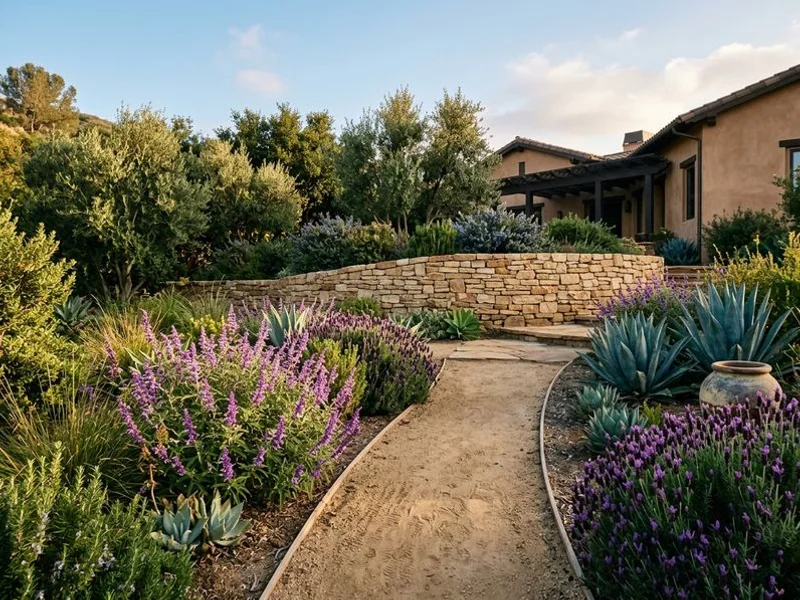
Some of the regionally appropriate plants commonly associated with these landscapes include California buckwheat, California sagebrush, manzanita, ceanothus, monkeyflower, foothill penstemon, and bunchgrasses. San Gabriel oak also fits the local native palette. These plants are not just attractive choices. They support a more resilient hillside because they can be matched to the site’s exposure and water availability.
The phrase drought resistant landscaping gets used broadly, but on a slope it should mean more than simply “low water.” It should mean plants that can stay attractive and functional under the real conditions of the site, not just survive a little neglect. Native plants often excel here because they fit the rhythm of the local climate and can be grouped according to sun and moisture needs.
The right plants in the right places
Slope stability is not achieved by planting the same species everywhere. Placement matters. A hillside with a wide range of exposures needs plant choices that reflect those differences. A plant that handles hot, dry, open conditions may not perform as well near a wall where reflected heat and irregular runoff create a different environment.
One of the most useful habits in hillside landscaping is to think in bands rather than in single specimens. Ground-hugging plants can occupy the most vulnerable soil zones. Shrubs can define the structure of the slope. Bunchgrasses can fill in open areas and reduce the look of bare earth. The result is a layered system that looks intentional and performs better than a patchwork of isolated shrubs.
Native habitat gardening also adds another layer of value. In the San Gabriel Mountains region, where many rare, threatened, and endangered species are part of the broader ecological picture, planting with regional natives supports a landscape that feels connected to place. That does not mean a backyard needs to become a restoration site. It does mean the plant palette can honor the local environment rather than fighting it.
There is also a practical side to this. Native and climate-appropriate plants often reduce dependence on frequent irrigation once established, though establishment still requires planning and patience. A slope planted well may need careful watering at first, but long-term water use can be much lower than a conventional lawn or high-input ornamental bed.
Water management is the hidden backbone of slope stability
If a steep slope fails in landscape design, water is usually part of the story. The runoff may not be dramatic at first. It can start as tiny rills that appear after irrigation or during a storm, then gradually widen as water keeps following the same path. That is why water management has to be designed into the site from the beginning.
California’s landscape guidance stresses irrigation assessment, soil, sun exposure, and plant selection before turf removal. On slopes, that advice becomes even more important. The goal is not simply to water less. The goal is to water in a way that supports plant establishment without pushing excess runoff downhill.
Efficient irrigation matters here. Older systems often apply water unevenly or too quickly for sloped ground to absorb. In hillside landscaping, irrigation retrofits can be just as important as new plantings. Slower application, careful zoning, and attention to where water lands can dramatically improve performance. This is especially relevant in drought resistant landscaping, where every gallon should be doing useful work.
Stormwater runoff also needs a place to go. A slope that sheds water without control tends to lose soil. A slope that captures and slows water, even modestly, gives roots a chance to hold it in place. That is one reason terracing and thoughtful hardscaping pair so well with native plantings. The built elements help shape water movement, and the plants make that movement less destructive.
Firewise thinking belongs in the same conversation
In foothill areas, slope stability cannot be separated from firewise landscaping. CNPS guidance for the region highlights ember-resistant zone rules and fire-resistant planting, which fits the realities of San Gabriel Valley hillside properties. A slope that is beautifully planted but flammable in the wrong places is not a success.
This does not mean eliminating all vegetation. It means choosing and arranging plants with care. Native plants can be part of a firewise design when they are selected and maintained properly. The practical focus is on spacing, maintenance, and plant placement around structures and access points. Hardscaping can help here too. Noncombustible surfaces, clear walkways, and well-placed retaining elements can support defensible-space planning without stripping the site bare.
The visual goal should be a landscape that still looks like it belongs on a hillside, not a sterile cleared lot. That balance is possible, but it takes discipline. A good design respects both water and fire, because on a steep slope those concerns are often interconnected.
A practical sequence for hillside projects
When a slope needs both stability and beauty, the sequence of work matters more than the number of plants on the plan. A rushed planting job over unresolved drainage issues usually costs more later. A more deliberate approach saves time and reduces guesswork.
Here is a simple order that tends to hold up well on real sites:
That sequence keeps the design grounded in how the site actually behaves. It also avoids a common mistake, landscape consultation which is to treat the slope as a purely decorative canvas until erosion shows up.
HOA rules and water-efficient landscaping
For many homeowners, hillside design is shaped not only by the site but also by HOA expectations. California water-restriction guidance says homeowners’ associations cannot prohibit certain water-efficient landscaping choices during drought-related restrictions. That matters for residents who want to replace turf, shift to native plants, or use a more water-wise planting scheme.
It is still wise to check local rules and plan early, especially when a hillside project involves visible changes to the front elevation or shared boundaries. But the larger point is reassuring: water-efficient landscape choices have broad support in California, and the regulatory direction favors smarter use of water, not ornamental overwatering.
That is part of why native plant landscapes and drought-tolerant plantings are now so relevant in the San Gabriel Valley. They are not fringe ideas. They align with state water management goals, local hillside conditions, and the realities of long-term maintenance.
Where mistakes usually happen
The most common slope failures in landscape design are rarely dramatic design errors. They are usually smaller judgment mistakes repeated over time. A few stand out.
One is planting too sparsely and leaving too much bare soil exposed. That soil becomes vulnerable to erosion, especially before plants mature. Another is relying on irrigation that applies water too quickly, which can send runoff downhill instead of soaking into the root zone. A third is choosing plants based on appearance alone, without considering whether they match the slope’s sun exposure or water availability.
There is also the temptation to overuse hardscaping. A slope covered with too much impermeable surface can shed water aggressively and leave limited room for roots to do their stabilizing work. The strongest designs keep hardscaping focused and let plants carry much of the long-term load.
The best hillside projects usually show restraint. They use a few durable materials, a plant palette that belongs to the region, and a clear understanding of how water moves through the site. That combination often ages better than a highly ornamental design that ignores the slope’s basic needs.
A landscape that fits the place
Steep slopes in the San Gabriel Valley ask for a landscape that is practical first and attractive by design. Hardscaping provides structure, access, and drainage control. Native plants provide root support, drought tolerance, and a stronger connection to the local landscape. Together, they create a hillside that is better prepared for erosion, water scarcity, and firewise planning.
That is the real strength of this approach. It does not fight the slope. It works with it. It respects the way water moves, the way sun hits exposed ground, and the way California native plants behave in difficult conditions. For homeowners planning a hillside transformation, that usually leads to a more durable, lower-maintenance, and more regionally appropriate result.
A steep slope will never be as simple as a flat lawn, and that is precisely why it deserves a more thoughtful design. When hardscaping and native plants are chosen with care, the hillside becomes less of a liability and more of an asset, one that holds soil, conserves water, and reflects the character of the San Gabriel Valley without fighting the land beneath it.