
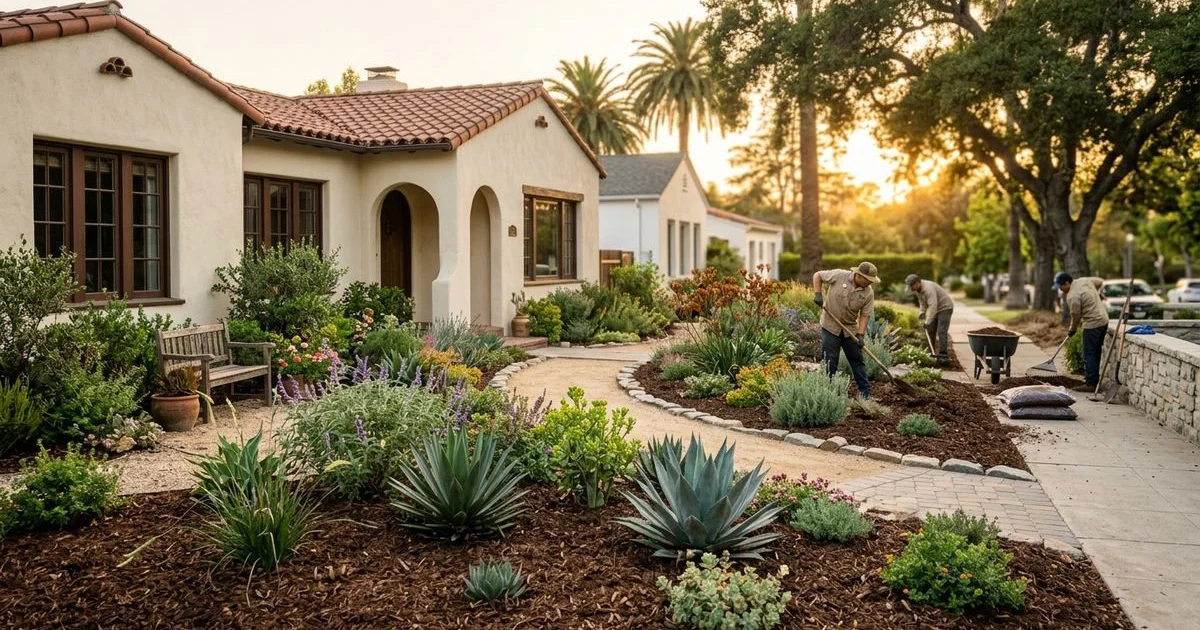
Fire-Resistant Landscaping for Hillside Properties
Hillside properties ask more of a landscape than flat ground ever will. Soil moves, water runs off faster than it can soak in, wind behaves differently from one exposure to the next, and every planting decision affects both fire safety and erosion control. On a steep lot, landscape design is never just about appearance. It is about keeping the ground where it belongs, using water carefully, and making choices that reduce fuel near the house without stripping the site of all character.
That balance matters especially in places like the San Gabriel Valley, where hillside lots are part of the visual identity of the region and where drought-tolerant plantings, water-efficient landscapes, and careful firewise planning all have practical value. The best hillside landscaping does not try to fight the terrain. It works with it. It uses hardscaping to stabilize circulation and planting areas, chooses plants that fit local climate and microclimate conditions, and sets up irrigation so water goes where it is needed rather than down the slope and away from roots.
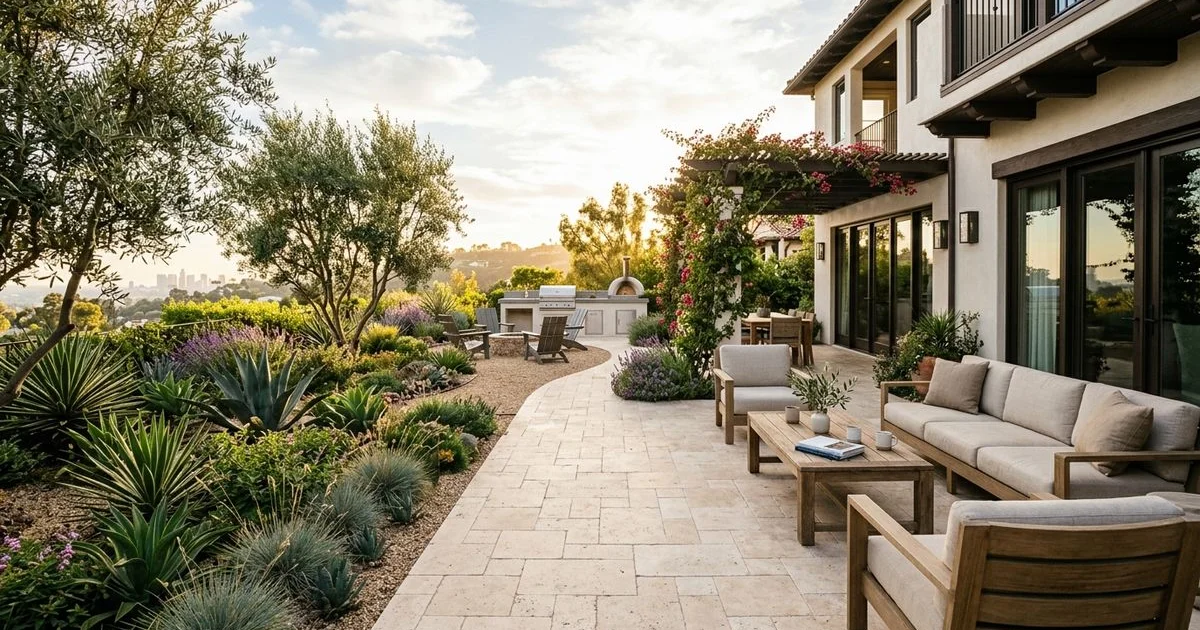
The real job of a hillside landscape
A good hillside landscape does several jobs at once. It slows runoff long enough for soil to absorb moisture. It holds the slope in place with roots, groundcover, and carefully arranged hardscaping. It reduces the amount of combustible material immediately around the house. It also creates a landscape that can survive in a dry climate without constant correction.
That combination is where many projects go wrong. Some homeowners focus only on looks and end up with a slope that erodes after the first heavy watering. Others focus only on fire concerns and clear everything down to bare dirt, which can leave the hillside exposed, unstable, and hard to maintain. The better approach is more disciplined. It starts with the site itself, especially soil, sun exposure, existing drainage, and the way water currently moves across the property. California’s water agency recommends exactly that kind of assessment before turf removal or major landscape change, and the advice is sound. On a hillside, skipping that step usually costs more later.
Microclimate matters too. One part of a slope may face full afternoon sun and dry out quickly. Another may sit in the shade longer, hold moisture, or collect windblown debris. A plant that thrives on one section of the lot may struggle ten feet away. That is why hillside landscaping is never a one-size-fits-all exercise, and why plant selection by microclimate is not a luxury. It is basic risk management.
Start with structure, not plants
When people picture landscaping, they often jump straight to plants. On a hillside, the more durable work usually comes before any planting goes in. Hardscaping can define edges, slow water, and create accessible maintenance zones. Retaining walls, stepping paths, terraces, drainage channels, and rock features all have a role when they are designed carefully and installed for the slope’s actual behavior.
Hardscaping is especially valuable near the home, where fire-resistant landscaping often needs a cleaner, less combustible surface. A gravel strip, paved patio, or well-planned walkway can create separation between the structure and heavier planting beds. It also makes maintenance easier. If you can reach irrigation valves, prune overgrowth, and inspect runoff without climbing through dense shrubs, the landscape will stay safer and healthier over time.
The key is restraint. Hardscape should not look like it was dropped onto the slope to solve every problem at once. Too much impervious surface can increase runoff if it is not graded correctly. Too many walls can create odd water pockets or maintenance headaches. On a hillside, the best hardscape often feels almost invisible because it simply organizes the terrain into usable, stable parts.
Fire-resistant does not mean bare
There is a common misunderstanding that fire-resistant landscaping means sparse landscaping. In practice, the safest hillside designs are usually planted, but planted intelligently. What matters is the character of the plant material, the spacing, and the maintenance pattern.
Woody plants with excessive dry litter near the base, dense piles of dead material, and neglected shrubs are all avoidable liabilities. By contrast, lower-growing plants, well-pruned shrubs, and plants with more moisture in their tissues can be part of a firewise plan. Native and climate-appropriate species often fit well because they are better adapted to regional conditions and do not demand constant irrigation to stay healthy.
In the San Gabriel Valley and surrounding foothill areas, local plant references naturally include California buckwheat, California sagebrush, manzanita, ceanothus, monkeyflower, foothill penstemon, bunchgrasses, and San Gabriel oak. Those plants are not interchangeable, and they do not belong everywhere on a slope. But they do illustrate the kinds of species that can support a landscape built around climate fit, habitat value, and lower water demand. That is a far more durable strategy than forcing thirsty ornamentals onto a hot, exposed hillside and then trying to keep them alive with extra irrigation.
A well-designed planting plan also respects defensible space. Near the house, the composition should be simpler and easier to maintain. Farther from the structure, planting can become fuller and more habitat-oriented if the site allows it. The transition should feel intentional rather than abrupt.
Water management is the backbone of the project
On a hillside, irrigation is not just a plant-care issue. It is a slope-stability issue. Water that is applied too quickly, too often, or too high on a slope can move downhill before it is absorbed. That can waste water, weaken soil structure, and create drainage problems at the bottom of the property or near foundations.
California’s landscape guidance emphasizes reviewing irrigation, soil, sun exposure, and plant choice together. That advice matters because each part affects the others. A drought-tolerant landscape is not simply a collection of low-water plants. It is a system built around realistic water use, proper scheduling, and compatible plant communities. The state’s Model Water Efficient Landscape Ordinance reinforces that direction for new and renovated landscapes, encouraging efficient irrigation, climate-appropriate plants, alternative water sources where appropriate, and water budgeting.
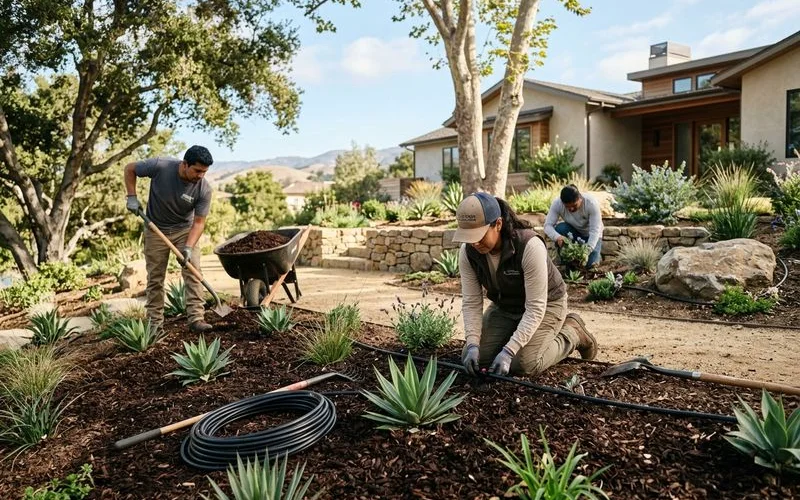
For hillside properties, that often means retrofitting irrigation rather than leaving an old system in place. Older spray patterns can be especially inefficient on slopes because water hits faster than the soil can absorb it. Drip irrigation is often a better fit for many planted zones, though it still needs careful layout and regular inspection. Even with drip, emitters can clog, lines can shift, and a small leak can become a big problem when it local landscapers in Pasadena runs downhill unnoticed.
The most practical approach is usually to divide the property by exposure and plant needs rather than treat the whole slope as one watering zone. A shaded lower section, a full-sun upper terrace, and a native planting band near the edge may all require different schedules. That is normal. It is also one reason retrofit work pays off more than trying to make an old system do a new job.
Erosion control comes before polish
A hillside can look beautiful and still fail if erosion is ignored. Bare soil, concentrated runoff, and poorly anchored plantings will quickly show their weaknesses. The first heavy rain or the first overwatering cycle often reveals what the design missed.
Good erosion control on a slope usually combines several measures. Plants with useful root structures help stabilize soil, but they need time to establish. Mulch can reduce evaporation and soften raindrop impact, yet it should be used in a way that does not create fire risk near the house. Terracing or other grade changes can reduce the distance water travels downhill. Small swales or drainage features can slow runoff and give water a better chance to infiltrate. These are not flashy moves, but they are the moves that keep a hillside functioning.
There is also a timing issue. Newly planted slopes are vulnerable long before roots knit the soil together. During establishment, irrigation has to be more attentive than it will be later, but not excessive. Too little water and the young plants fail. Too much and the slope softens or sheds soil. The right amount depends on exposure, soil, and the plant palette. That is where hands-on observation matters more than rigid formulas.
Designing for defensible space without losing the landscape
Defensible-space planning does not require a landscape that looks stripped or barren. It requires a landscape that reduces ignition risk around the structure and remains maintainable under dry conditions. The practical question is not whether a property has plants. It is where those plants are, how they are maintained, and how much combustible material is allowed to collect around the home.
The area closest to the structure deserves the most disciplined treatment. This is where people often use hardscaping, low-growing planting, and carefully spaced shrubs to create cleaner edges. A gravel band, paved terrace, or other noncombustible surface can make the transition from house to landscape clearer and easier to maintain. Farther out, plant masses can become broader if they are chosen and managed with firewise principles in mind.
On hillside properties, this can be tricky because visual continuity matters. A slope full of isolated specimens can look disjointed, while a densely planted slope can look lush but become difficult to maintain. The middle ground is usually a layered design with clear separations between plant groups, open access points for maintenance, and strong emphasis on pruning and debris removal.
The maintenance side is where many plans either succeed or fail. A fire-resistant landscape is not set-and-forget. Dry litter collects in native shrubs. Irrigation shifts. Branches grow toward structures. A slope that was compliant one season can become overgrown the next if no one is watching it.
Native habitat and waterwise design can work together
There is a persistent myth that waterwise landscapes are sterile or ecologically thin. That is not true when the plant palette is chosen well. California native plants can support habitat while still fitting the realities of a dry hillside. The point is to match species to exposure, drainage, and maintenance expectations, not to assume that every native is automatically appropriate for every site.
In foothill and hillside settings, native habitat gardening can be both resilient and visually rich. California buckwheat offers texture and seasonal interest. Ceanothus brings structure, though some forms need room and the right exposure. Monkeyflower and foothill penstemon can soften transitions. Bunchgrasses can help fill space without demanding constant water, and they also fit well into layered compositions that reduce the look of bare ground. San Gabriel oak, where appropriate, connects the landscape to the local character of the region.
That said, native does not mean no care. Some native plants can struggle if overwatered. Others need more space than homeowners expect. Manzanita, for example, can be a beautiful part of a hillside planting, but only if the site suits it and the planting plan respects mature size. Good landscape design pays attention to the plant’s adult shape, not just the look of the nursery pot.
What to review before removing turf or reworking a slope
Turf removal on a hillside can make sense, especially where water use has become hard to justify or where the lawn is not functioning well. But replacing turf without a site assessment is a mistake. California guidance recommends reviewing irrigation, soil, sun exposure, and plant selection before removing turf, and that sequence protects both the property and the budget.
A few practical questions usually settle the direction of the project:
Those questions sound basic, but they prevent the most expensive missteps. They also help homeowners decide whether a full regrade is necessary or whether the site can be improved with targeted changes. Not every slope needs dramatic intervention. Some need better irrigation, better plant spacing, and a few well-placed hardscape features. Others need drainage corrections before any planting work begins.
HOA rules and homeowner rights
Homeowners in common-interest developments sometimes assume that association rules can override all landscape choices. California water-restriction guidance says otherwise in important respects. During drought-related restrictions, homeowners’ associations cannot prohibit certain water-efficient landscaping choices. That does not mean design is unregulated, but it does mean water-wise decisions have legal backing that homeowners should know about.
For hillside properties, this matters because the most sensible landscape is often the one that reduces water demand, improves slope stability, and fits the local fire context. If an association prefers a traditional lawn look while the site demands something more efficient and safer, that tension needs to be handled carefully and with the governing rules in mind. The strongest case is usually a practical one. A water-efficient, slope-appropriate design is easier to justify when it clearly improves drainage, maintenance, and fire resilience.
The quiet discipline of maintenance
The finished landscape is only part of the story. What keeps a hillside property safe is maintenance that stays ahead of growth and debris. That means checking irrigation for leaks or overspray, removing dead material before it accumulates, pruning so shrubs keep their intended form, and watching for bare soil after storms or overwatering. It also means accepting that some sections of the property will need more attention than others.
A steep lot asks for observation. A plant that looked healthy in spring may dry out quickly in late summer sun. A drainage path that worked for one season may need clearing after leaf drop. A slope that was well planted two years ago may need infill where plants never fully established. These are not failures, just the normal conditions of hillside landscaping.
The most successful properties tend to have a clear rhythm to them. Hardscaping gives structure. Drought resistant landscaping reduces water demand. Firewise planting choices reduce fuel near the home. Irrigation is tuned to the slope rather than the flat lot model most systems inherited. The result is not only safer, but more coherent. The landscape starts to look like it belongs to the terrain instead of being imposed on it.
Hillside properties reward patience and punish shortcuts. When the design respects water, fire, and gravity at the same time, the landscape becomes easier to live with year after year. That is the real measure of success.